AI can write a concept in minutes, but not the reason behind it. Opensurvey Concept Studio builds ideas on a decade of consumer data and keeps the synthetic panel's reactions attached as evidence.
Can an AI-Written Concept Go to the Review Meeting?

The Data Behind Concept Studio: Opensurvey's Food Diary

How to Interpret Concept Screening Results: Averages, Segments, and Evaluation Reasons

How Closely Do Synthetic Panels Match Real Consumers?

Why Synthetic Panel Scores Differ from Real Consumer Purchase Intent
‹
›
Can an AI-Written Concept Go to the Review Meeting?
Opensurvey has launched Concept Studio, an AI product for new product development.
Concept Studio is an AI-based feature you can use at the idea-screening stage, before you run a full-scale concept study. In Concept Studio, you generate new product ideas in the food and beverage domain, and the moment an idea exists, you can ask a synthetic panel for its purchase intent right away. Ideas are generated on the basis of the consumer data Opensurvey has built over ten years, and a synthetic panel, created from Opensurvey's own panel data, looks at each idea and answers with its purchase intent and the reasons behind it.
In this article, we'll walk through the main features of Concept Studio and explain what we set out to make different, and why.
Where new product ideas actually come from
Until now, the raw material for ideas was memory
When you have to come up with a new product idea, what do you do first?
Usually you dig through trend reports, scan competitors' new launches, and reopen last year's research. But you don't remember exactly where everything was, and above all, there's never enough time to do all of it properly. So in the end you start from whatever is still in your head. It's the fastest option.
Within a limited amount of time, the fastest search bar is your own memory. So even after a team gathers ideas, tables them, narrows the candidates, and shapes a few into concepts, the entire candidate pool is, in effect, derived from what was already in one person's head.
Coming up with ideas looks like a problem of creativity, but in practice it's closer to a problem of recalling and gathering the relevant context. Most of the time goes into finding what's relevant, reading it, and connecting it.
AI generates concepts in minutes, but not the reason why
With an LLM alone, you can produce a concept that reflects a target user, a usage occasion, and key keywords in a very short time. The more honest fact is that even without much of that input, an LLM already produces results of surprisingly high quality. The cost of writing a concept has now dropped close to zero.
So does faster generation bring the new-product-development breakthrough we hoped for? It may be the opposite. When there are more candidates, deciding what to develop, what to drop, and what to take to real consumers gets harder. The problem isn't that there are many candidates. It's that you, who never saw the decision process because these didn't come out of your own head, are now asked to choose among things an LLM produced for you.
On top of that, we work at a company that actually makes physical products. It's hard to commit real money to production just because something looks plausible. When someone asks "why did you go with this concept," you can't answer "the AI picked it."
An LLM writes the concept; Concept Studio writes where it source
Concept Studio doesn't start from a blank screen. It starts from a decade of meals.
The data Concept Studio builds on begins with the Opensurvey Food Diary data that Opensurvey has accumulated over ten years. It records, season by season, what respondents ate and drank across a full week. Because it captures not only what people say they like but what they actually ate, it's a rare kind of data where a person's values and attitudes sit alongside their behavior.
It records what a given person considers important, what they actually put on the table on a weekday evening, and how those two things diverge. In our experience, most of the context you need for a new product idea comes out of that gap.
In Concept Studio, you enter a category, a target, and a launch objective, and it finds and connects the relevant material from the data. Ideas are built on top of that evidence. So a Concept Studio result doesn't just give you a concept sentence: it comes with the consumer shift it started from, the data that supports its potential, and why it's this candidate rather than another.
Filtering signal from noise before the LLM steps in
At this point you might think a general-purpose LLM could do something similar. And it's true that a general LLM can produce plausible new product ideas and even generate imagined consumer reactions. But those results mostly lean on the general world knowledge the model was trained on and the plausibility of language. How real consumers actually lived and what they actually chose doesn't directly become the basis. That makes a big difference downstream (for example, in the share of purchase intent and the reasoning behind it).
The Opensurvey team defined the best way to use an LLM as a question of what material you feed into the LLM's knowledge so it can reason well, and we put our effort there.
What Concept Studio learned isn't the names or patterns of existing products. It's the attributes consumers responded to, and the combinations of those attributes. From ten years of dietary data, it sees how people's behavior has shifted over time; from real concept-study data, it sees which combinations of flavor and ingredient people prefer and which they avoid. Who eats that combination, when, and in what situation goes in as well. And the thing doing this learning isn't the LLM. It's a machine-learning model we designed on top of data Opensurvey collected directly.
To put it simply: these models find what's promising, and the LLM takes that result and turns it into an idea a person can review.

How a synthetic panel evaluates a new concept
Who evaluates a combination no one has seen?
By this point, we can explain where a concept came from. The data tells us which attributes people have responded to, how, and where that trend is heading.
But what Concept Studio just made is likely a combination that didn't exist before. The response to each existing attribute is in the data, but it's possible no one has actually seen this newly assembled combination yet. So the answer to whether this concept will sell isn't anywhere in the data.
You could just ask real consumers, but that's not so easy. When we asked 250 people who work on new products, 72% said it's hard to test consumer reactions in advance during development.
We don't think the reason is only money and time. To open a study, you first have to decide what to ask, and to do that, you have to picture in advance what answers might come back, and what you'd want to know next once they do. In other words, you can only ask as much as you already know, and imagining all of that ahead of time is hard for an idea you yourself are considering for the first time.
Maybe that's also why asking consumers keeps getting pushed to after the concept is fully shaped.
A synthetic panel answers even your smallest question
If starting is the hard part, one way through is to lower the barrier with questions.
We often struggle to start at all because of some small worry in the back of our minds, one that only shows up against the big picture. Here, a synthetic panel, which isn't a real person, greatly reduces that hesitation. Because it answers earnestly no matter what you ask, without judging the quality of the question, a synthetic panel contributes a great deal to finding the direction you should take.
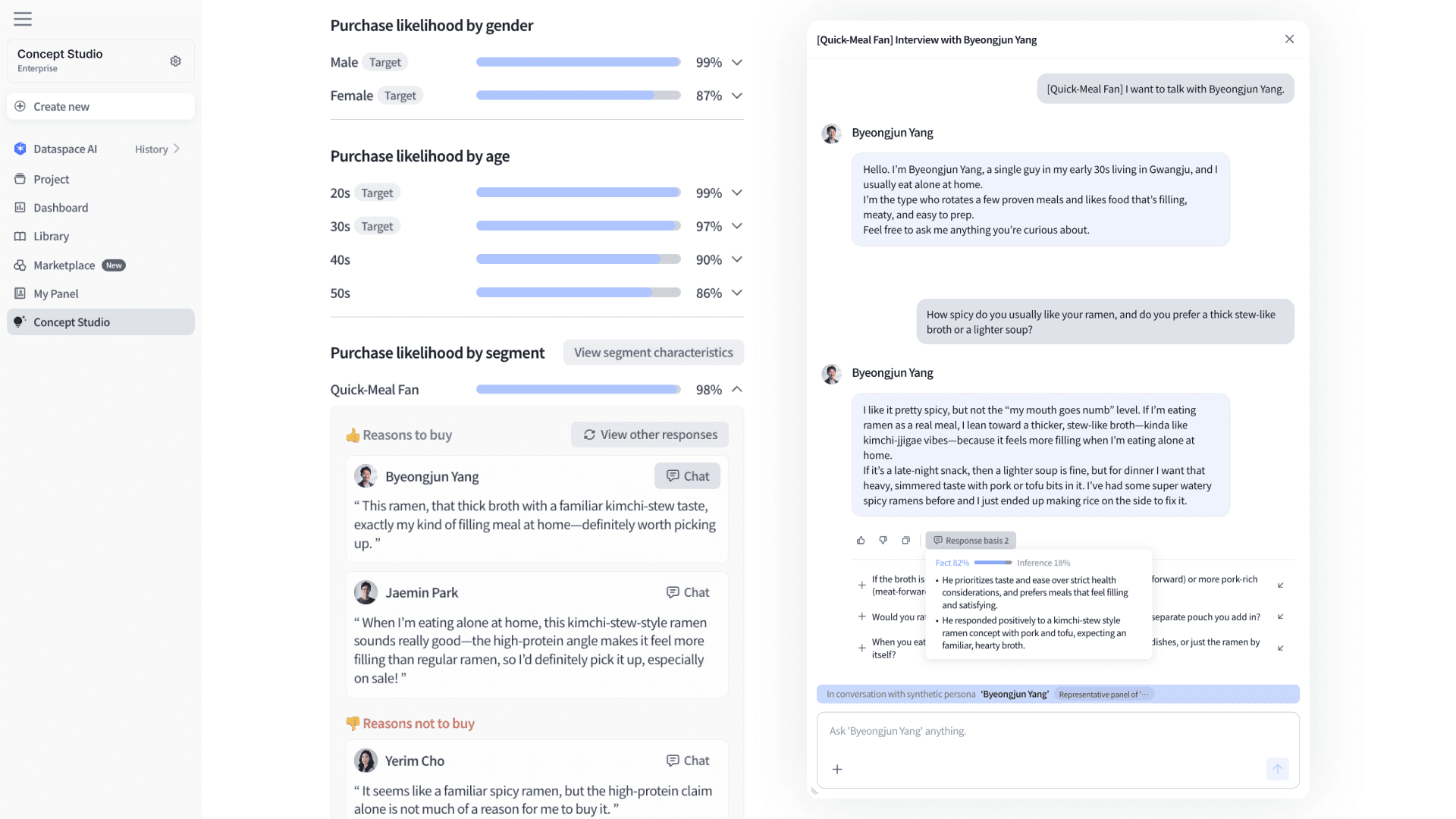
That's why Concept Studio uses a synthetic panel. Concept Studio is built so that, for an idea you just made, you can get purchase intent straight from a synthetic panel. And it tells you the reasons behind whether people would buy it or not.
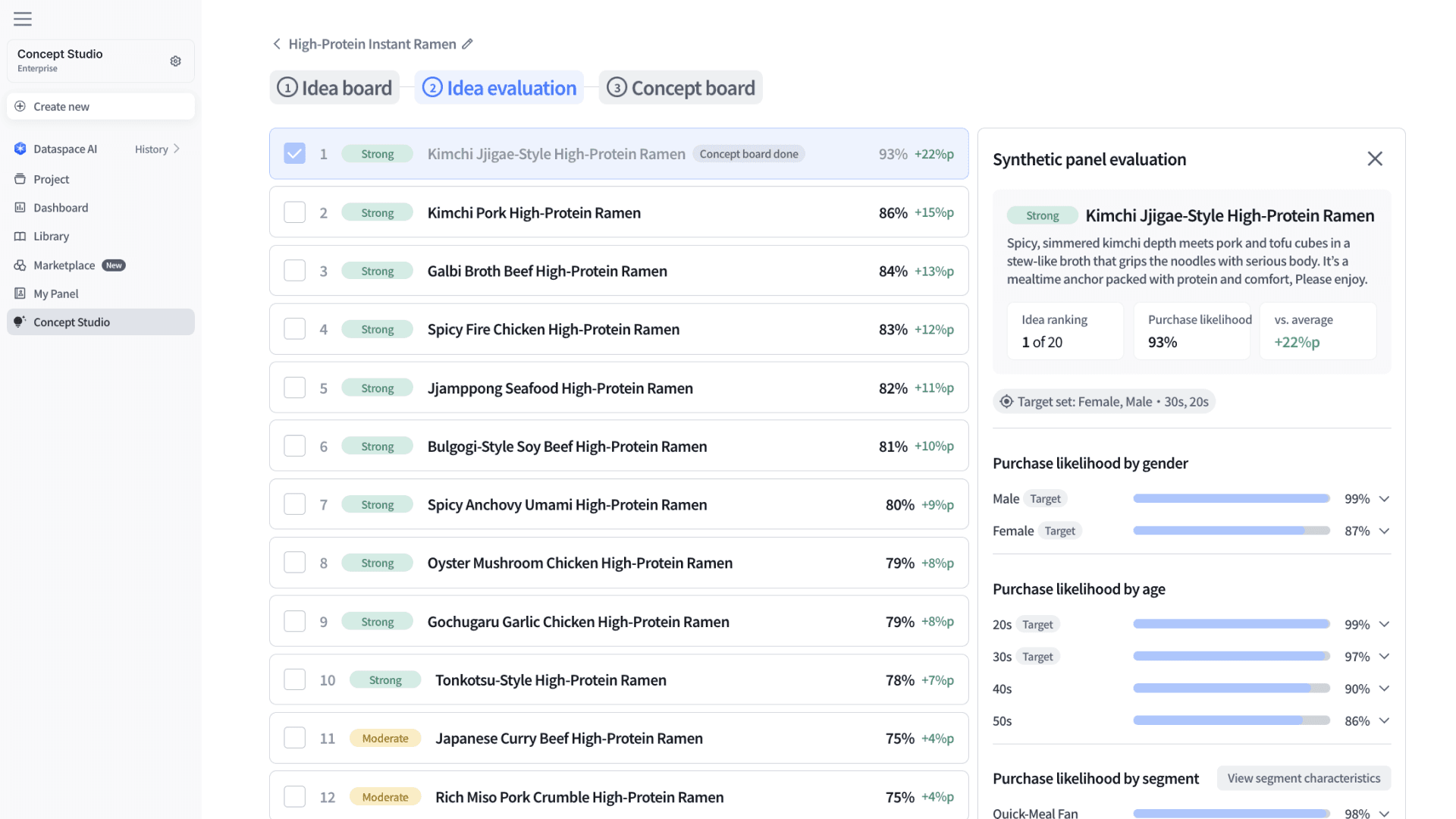
How Opensurvey builds its synthetic panel
So how did the Opensurvey team build this synthetic panel? The starting point is the respondents who actually left records in Opensurvey Food Diary. Using statistical methods, we extract what foods a given person eats together, which combinations of flavor and ingredient they prefer, and with whom, when, and how they eat them.
Opensurvey Food Diary isn't a survey about a single meal. It's data that records a whole week at once. So within one person, you can see how meals flow across times of day and across weekdays and weekends, and who they're with, where they are, and which food leads to which next. Instead of a profile that sums up taste in one line, you see it through a week of living.
On top of that, we layer in what the person considers important to build their narrative, and the LLM answers on the basis of that narrative. It's the same structure as generating concepts earlier: statistics and machine learning find the pattern, and the LLM takes the result and puts it into words.
Validating synthetic panels against real consumers
When you build any prediction or simulation system, evaluation matters most. An AI system you can't evaluate is the same as one you have no plan to use more than once.
From the moment we resolved to build the system Concept Studio needed, the first things we discussed were two: what to evaluate and how, and a structure that lets us evaluate and improve continuously.
We think an evaluation metric isn't about whether it's exactly identical to a consumer,[*] but about whether it's accurate enough for the role we mean to give it.
A narrative isn't one person transferred as-is; it's a summary of their characteristics. So we didn't set out to reproduce an individual's response exactly. In keeping with Concept Studio's purpose at the idea-screening stage, we set the metric around what people prefer and don't prefer among several candidates, as a basis for narrowing the early pool. We showed Opensurvey's real panel the same 69 unbranded concepts (across 8 categories) that the synthetic panel had answered, and compared the responses. The average rank correlation by category (Spearman ρ) was 0.8.
In rank correlation, 0.8 means the two groups' orderings agree strongly, though not to the point of matching every rank one for one. Still, it's plenty useful for separating the candidates worth keeping from the ones to set aside here. That is exactly the role we gave it in early screening.
And what we confirm with the real panel comes back into the model. Where and how much the synthetic panel's answers diverged from real consumers' answers becomes input for correcting the model. Having a real panel means we can verify, and being able to verify means we can improve.
The direction we recommend is clear: use the synthetic panel to build a wide early pool and narrow it, and confirm the decisions that are costly to get wrong with real consumers. The two aren't competing or replacing each other; they split the roles according to the risk of the decision.
Why an AI concept needs evidence to move forward
Let's return to the first question. An AI-written concept, on its own, can't go to the review meeting (the internal session where new product concepts are formally evaluated before they move forward). It can go only when the evidence it came from and how consumers reacted to it are attached. What Concept Studio makes isn't an idea. It's the reason that idea was chosen.
What we want to build isn't an AI that writes plausible concepts, nor an AI that replaces real consumers. It's a product where the records consumers actually left become the raw material for ideas, and where the answer to each idea stays on as evidence.
Synthetic Consumer
AI
Product Story


Opensurvey
Opensurvey is an AI research tech company. We connect the entire research process—from research planning to data collection and analysis—with AI, and we offer a platform, expert research services, and a consumer panel all together. We work alongside industry-leading companies such as Samsung Electronics, P&G, CJ CheilJedang, and Woowa Brothers, and over the past 14 years we have served some 3,000 corporate clients across 25,000 projects. With ISMS-P, ISO/IEC 27001·27701, and ISO 20252 certifications, along with full membership in ESOMAR, we meet international standards in both security and research quality.
Dataspace
Dataspace is an AI-powered consumer intelligence platform provided by Opensurvey. An orchestrator that understands research context, together with specialized agents for each stage, accompanies the entire research process—from planning to data collection, analysis, insight reporting, and sharing. Its Dual Layer architecture, which separates statistical computation from AI inference, ensures analytical accuracy, and every insight is presented with evidence grounded in real consumer responses. You can connect with consumer panels in 20 countries including Korea, collect data directly from your own customers, or use APIs to integrate with external platforms such as CRM systems. The consumer data and research context accumulated in Dataspace remain as a company's intelligence asset. Building on this, you can create synthetic consumers tailored to your own brand to hold conversations with them and predict market responses.
ⓒ Opensurvey
All copyrights to Opensurvey's content belong to Opensurvey Inc. When citing, you must always indicate the source; even with attribution, copying content in full, unauthorized reproduction, and redistribution are prohibited. When citing the source, please include the name of the Opensurvey blog and the URL or link of the article cited. ex) Opensurvey Blog, article URL or link