Research has long been the domain of experts. Opensurvey rebuilt Dataspace from the ground up with an AI agent at its core to change that. The developers and PM who made it happen share the story behind the build.

Research has long been the domain of experts. If you haven't done it before, it's hard to know where to begin — how to design a survey, how to analyze the data you collect.
To lower that barrier, Opensurvey rebuilt its consumer intelligence platform Dataspace from the ground up with an AI agent* at its core in April 2026.
*AI Agent: An AI system that goes beyond simply answering questions — it autonomously plans, selects the right tools, and executes tasks (survey design, data analysis, etc.) based on the user's goals.
Now, all you need is a business question. The AI defines the research objective, designs the survey, supports data collection, and analyzes the results. Anyone who needs consumer data can get expert-level insights — in a fraction of the time and cost.
Behind that sits an intense period of building. We sat down with the developers and PM who built Dataspace AI — LG (Haeyong Jung), Mickey (Minje Choi), and Yoon (Jiyoon Jung) — to hear the story.
Part 1. So anyone can make decisions with data — not just researchers
Dataspace recently launched a full rebuild on an AI agent foundation. What role did each of you play in this project?
Yoon: I handled the overall problem definition. Starting from the question "why does Dataspace need AI right now?", I worked on defining what kind of users would use it, what value they'd get out of it, and what features were needed — then built it together with the team.
Mickey: I built the backbone of Dataspace AI, so to speak. My job was connecting the platform's existing tools — survey design, data analysis, and others — to an LLM, and building the orchestrator** that makes them all work together. I also handled the data analysis side: chart generation and report writing.
**Orchestrator: A framework that sits in the middle and controls the flow between multiple AI models and internal systems (survey editor, statistical analysis engine, etc.) so they work together seamlessly.
LG: I led the overall AI technology review and implementation as we rebuilt Dataspace into an AI platform. I oversaw the architecture design and led the development of the survey engine — which lets users design and edit surveys in natural language — and the search engine that lets users search their data in natural language.
Dataspace launched in 2023. What was the turning point that led you to bring AI into it?
Yoon: AI technology was already being applied across parts of Dataspace. What happened recently is that we finally connected it across the entire research process.
The emergence and spread of LLMs felt like an opportunity to deliver more of what Dataspace was always supposed to do. We always had a question after launch: "how do we get people to really use this well?" Users who knew research — who had experience — used Dataspace well. But others didn't. That's not surprising. To use research data for decision-making, you need to go through a whole chain of steps: defining the business problem, turning it into a research question, finding the right methodology. None of that is easy.
A lot of practitioners have never done research before, so starting feels daunting. Add learning a new platform on top of that and the to-do list gets overwhelming. We wanted to make it so that even if you don't know research — even if you don't know Dataspace — all you need is a question. If research becomes easy, Dataspace can become part of how people work every day.
With this rebuild, Dataspace can now reach users who aren't research experts. What did the product team prioritize when designing the experience for them?
Yoon: The core principle was "Output-first." Think about what happens if, at every step of survey design, you ask the user to approve which question type to use, how to set up the respondent target, and so on. For someone who doesn't know research, being asked to make expert-level decisions is going to feel hard — and they'll probably give up. On the other hand, reacting to a visible output with "looks good" or "can you add this?" is much easier.
So we minimized the number of decisions users have to make. We trained AI on expert methodology so it makes the decisions and produces the output — the user just focuses on their business question. The AI shows a brief, survey design, or analysis result first, and the user refines it from there.
Part 2. Transplanting research expertise and tacit knowledge into AI
Making Dataspace AI genuinely expert at research must have been a core challenge. How did you get 15 years of expertise and know-how into AI?
Yoon: The product team built the implementation, but the underlying expertise came from our internal research professionals. There's a huge amount of tacit knowledge in the research industry — and LLMs don't know most of it. We took the structured knowledge documents inside Opensurvey, the advisory notes and feedback accumulated in Slack and Google Drive, and the principles our experts follow at each stage — and embedded all of it directly into the prompt layer. The same goes for how we analyze data and write reports — those follow our internal experts' standards. One concrete example: HY (CEO Heeyoung Hwang's internal nickname) directly wrote the prompts reflecting her preferred report style. We've been updating and refining prompts based on what gets validated in the field. Honestly, having an in-house team of research experts is an enormous asset when you're building something like this. Very few companies can hear high-level expert feedback daily and ship it into the product the same day.
Is there a real difference between designing a survey with a general-purpose AI versus Dataspace AI?
Yoon: If you ask a general-purpose AI to "create a survey to measure brand preference," you'll get something that looks reasonable on the surface. But to a practitioner's eye, the mistakes that introduce bias or contaminate data happen all the time. Dataspace AI has been trained on the tacit knowledge of the research industry through its prompt and knowledge base — that expertise is the foundation that ensures a reliably well-designed survey.
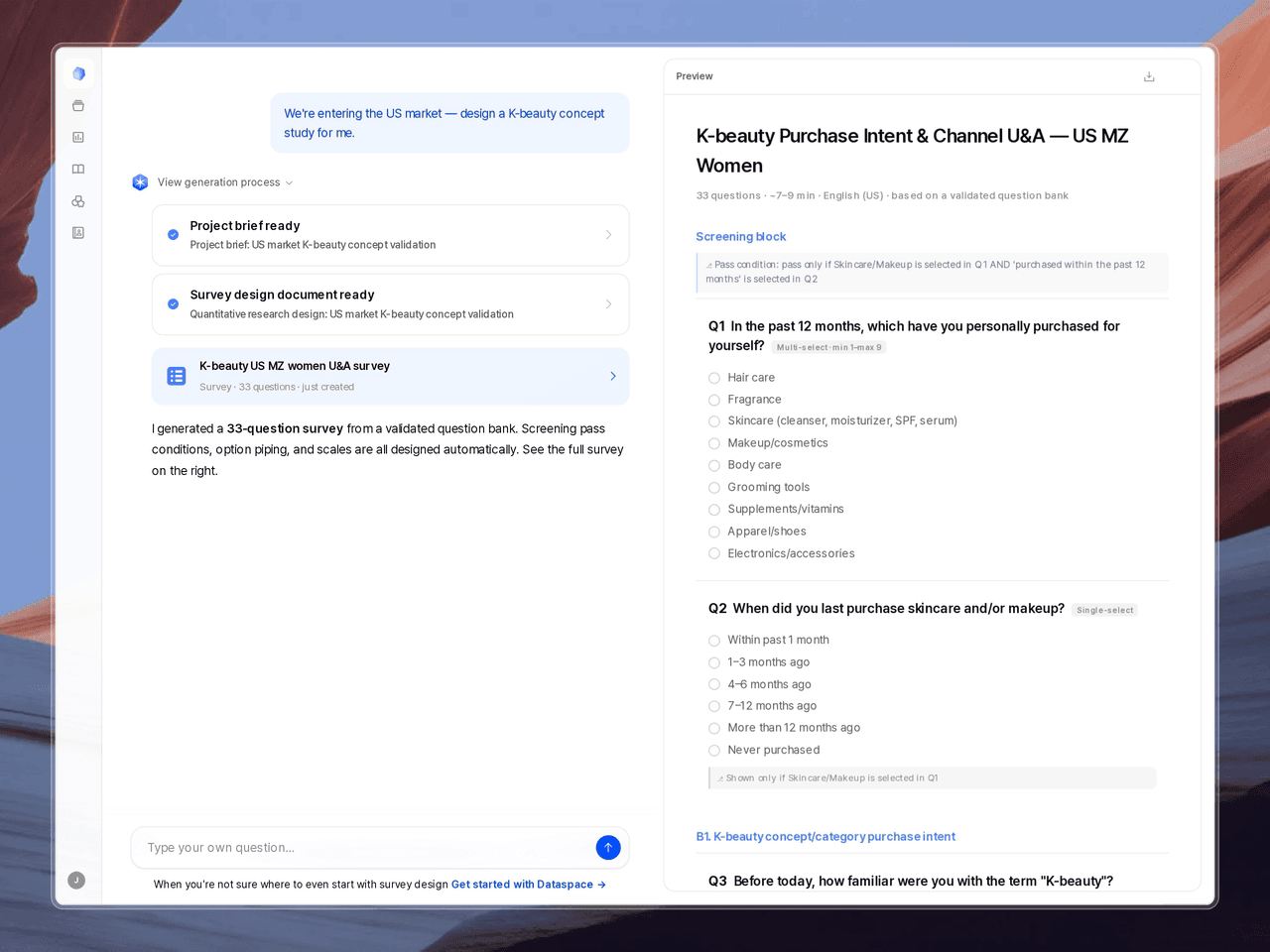
LG: On the engineering side, we focused on making the LLM produce stable survey designs based on well-crafted prompts. Dataspace AI doesn't call the LLM just once when designing a survey — we designed a four-step process to keep quality in check. First, the LLM draws the overall blueprint of the survey. Then it enriches that with research domain context and vocabulary. Next, it generates the detailed questions block by block. Finally, it reviews the full survey and applies the necessary logic rules. We also focused heavily on building a structure that doesn't trust the LLM — it verifies. LLMs are free-spirited, as anyone who's used ChatGPT, Gemini, or Claude knows. So instead of expecting free-form answers, we enforce a structured output format. And once the final output is produced, a validation layer at the system code level checks it again.
Part 3. The engineering structure that controls accuracy and uncertainty
What about data analysis? Opensurvey has always emphasized the strength of its analysis features — what challenges came up when you added AI?
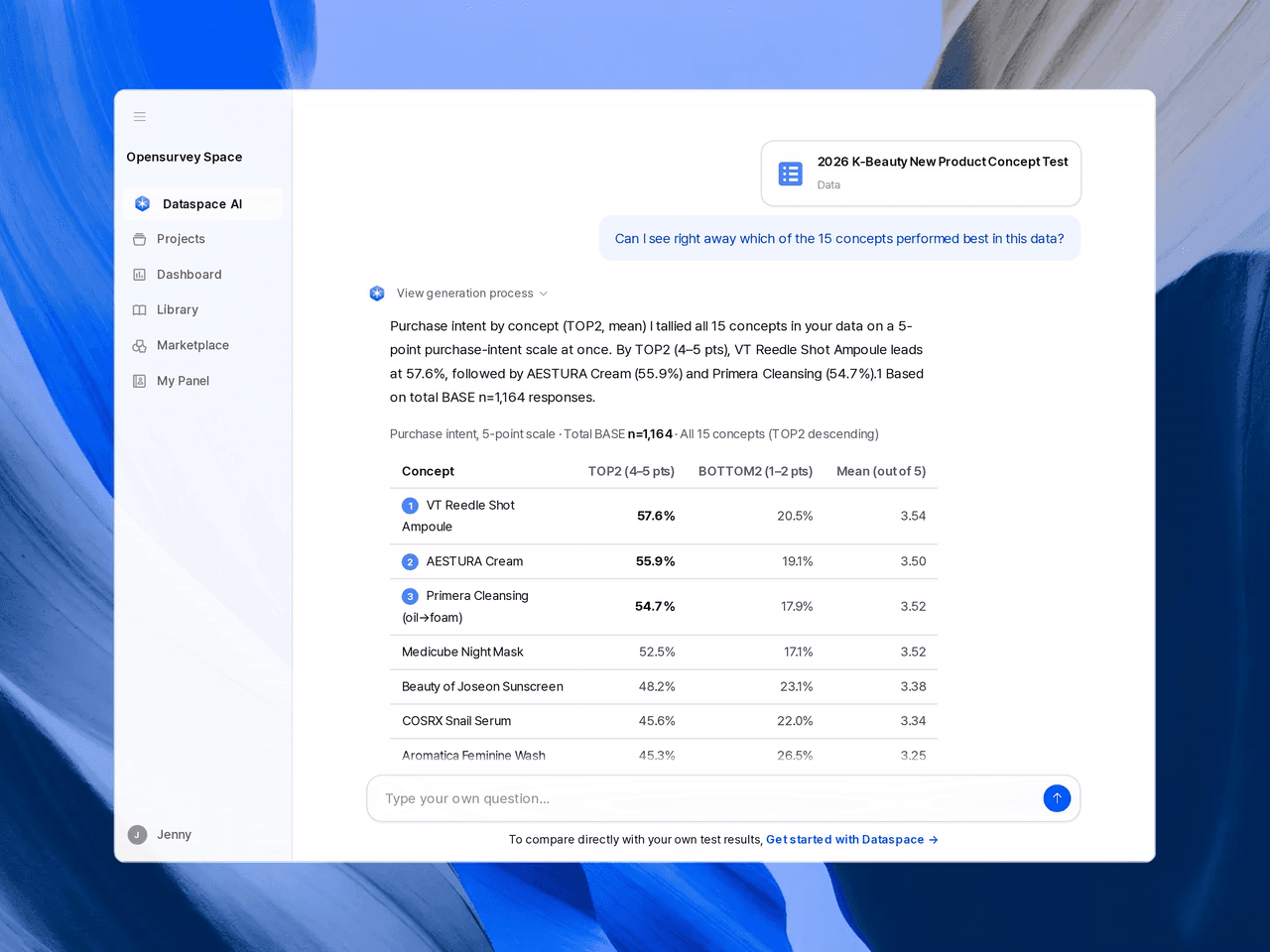
Mickey: This was our first time building an AI product, so we ran into a lot of different errors. The core issue with plugging LLMs into the analysis function was accuracy. LLMs are great at producing plausible-sounding text — but Dataspace AI needs to deliver correct outputs. In data analysis, even a small error collapses trust. And LLMs are probabilistic models — they complete text by statistical prediction, so they fundamentally can't guarantee 100% accuracy.
To solve this, Dataspace introduced a Dual-layer structure that separates roles clearly. Numerical computation and calculation is not delegated to the LLM at all — it's handled entirely by our own server engine, which has always performed flawless calculations. That's the Deterministic Layer at the front of the analysis pipeline. The accurate data it produces, along with the context of the user's business question, is then handed to the LLM — which focuses solely on interpretation and insight narration. That's the Generative Layer that follows. Numbers can't be wrong. That's why we built the structure this way, and it's one of Dataspace AI's key differentiators. General-purpose LLMs can produce numbers and text — but they keep getting the numbers wrong.
📌 Dataspace AI's Dual-layer structure
|
Getting AI to run coherently across the entire process — from survey creation to analysis — while maintaining consistent quality sounds like extremely high engineering complexity.
Mickey: To get AI working across our whole system, we had to teach it everything about our system — the question types supported in survey design, the logic rules, the analysis methods the system supports. But LLMs already come with their own general knowledge. So they'd sometimes try to do things their own way rather than using our tools, and make mistakes. And our survey and analysis tools are not simple — they support far more complex options than something like Google Forms or Naver Forms. Getting an LLM to use our system's tools to execute all of that correctly was genuinely hard.
LG: A lot of this comes down to LLM uncertainty. You can train an LLM to increase the probability of a certain response, but you can't guarantee 100%. We needed to ship a product that was close to 100%. Before AI, product development was binary — does it work or doesn't it? Once you add AI, it works, but then you're fighting with quality. Finding the methodology to keep quality consistently high wasn't easy.
Part 4. Beyond the binary — the fight for quality
It all seemed to come together so easily from the outside — but it sounds like it was a much bigger challenge than it appeared. What's the most memorable setback or lesson from that process?
LG: If users feel like the AI is just doing what Dataspace always did, that's a good sign — it means the AI is faithfully executing the existing features.
What we were going for wasn't a collection of sub-agents but a unified orchestrator that covers the entire research process. We wanted users to get real value from a single business question, without needing to know the domain or the product. That meant a lot of foundational work. Every existing feature in Opensurvey — data search, survey creation, data collection, analysis, report writing — had to be redefined and built as tools (MCP) that an LLM could understand and use. We were also building AI service maintenance and operations from scratch. The whole team ran intense technical study sessions and experiments in parallel to find the answers.
Yoon: Right. Dataspace isn't a chatbot that gives general advice — it's a product that supports real business decisions. We needed to guarantee expert-level output, not just task execution. That meant building evaluation systems and pipelines, running iterations, and continuously improving output quality.
The hardest part was diagnosing quality problems. When results weren't good enough, or didn't meet expert standards, there were a lot of places to look: the search tool, variable extraction, LLM interpretation. We kept debating whether to break things into sub-agents, whether to cut certain tools entirely — but we didn't compromise on the goal: an AI that gives expert-level insights from a business question alone. We set priorities and ground through the problems as a team.
Mickey: Getting the unified orchestrator to understand user intent, define what to do and in what order, and execute without errors was itself a massive engineering challenge. Early on, the models kept producing unexpected bugs. Once, during internal testing, the LLM's word-prediction mechanism caused it to output the full contents of our prompt — it saw a few words that appeared in the prompt and started completing them. Another time, an overloaded main LLM exposed internal system field names in the output.
Those experiences led us to the answer: don't tell the unpredictable LLM to control itself — build code-level guardrails around it. We built what's now the Compound AI System***. Critical constraints, validation, and security are handled firmly by the system code. The LLM is free to focus on insight narration. That's how we get the benefits of AI while keeping quality guaranteed.
***Compound AI System: An integrated structure that handles complex tasks by combining multiple software components — validation code, security layers, internal systems — rather than relying on a single LLM for everything.
What is the product team most focused on right now?
Yoon: The biggest priority for Dataspace in the second half of this year is synthetic consumers. The synthetic persona interview feature and the concept studio powered by synthetic panels are already live — and we'll be going deeper on both. Users can now go beyond using AI as a researcher or analyst and actually have conversations with virtual consumers to sharpen ideas and get real inspiration for their work.
LG: On the engineering side, we're moving past pure feature implementation — the focus now is quality improvement, API cost reduction, and operational stability.
Mickey: Quality improvement is the most important thing. There's almost nothing the platform can't do now. Most of what Dataspace could do before, the AI agent can do too — but there are still plenty of things it doesn't handle cleanly. We'll keep improving how well Dataspace AI works.
Dataspace AI is still evolving. We're refining the quality of AI responses and outputs, going deeper on synthetic consumer features, and building an environment where more people can make decisions with data. Experience the new way to do research — with an AI that actually knows research — on Dataspace.
AI Research
Agentic Research
Team Story


Opensurvey
Opensurvey is an AI research tech company. We connect the entire research process—from research planning to data collection and analysis—with AI, and we offer a platform, expert research services, and a consumer panel all together. We work alongside industry-leading companies such as Samsung Electronics, P&G, CJ CheilJedang, and Woowa Brothers, and over the past 14 years we have served some 3,000 corporate clients across 25,000 projects. With ISMS-P, ISO/IEC 27001·27701, and ISO 20252 certifications, along with full membership in ESOMAR, we meet international standards in both security and research quality.
Dataspace
Dataspace is an AI-powered consumer intelligence platform provided by Opensurvey. An orchestrator that understands research context, together with specialized agents for each stage, accompanies the entire research process—from planning to data collection, analysis, insight reporting, and sharing. Its Dual Layer architecture, which separates statistical computation from AI inference, ensures analytical accuracy, and every insight is presented with evidence grounded in real consumer responses. You can connect with consumer panels in 20 countries including Korea, collect data directly from your own customers, or use APIs to integrate with external platforms such as CRM systems. The consumer data and research context accumulated in Dataspace remain as a company's intelligence asset. Building on this, you can create synthetic consumers tailored to your own brand to hold conversations with them and predict market responses.
ⓒ Opensurvey
All copyrights to Opensurvey's content belong to Opensurvey Inc. When citing, you must always indicate the source; even with attribution, copying content in full, unauthorized reproduction, and redistribution are prohibited. When citing the source, please include the name of the Opensurvey blog and the URL or link of the article cited. ex) Opensurvey Blog, article URL or link